Industrial Electrification in New England: Meeting Climate Targets While Cutting Costs?
Four New England states are home to large, high-emitting industrial facilities—and have climate laws that require cuts to greenhouse gas (GHG) emissions: Connecticut, Maine, Massachusetts, and Rhode Island. A new report prepared by Synapse Energy Economics (Synapse) and commissioned by the Conservation Law Foundation shows how industrial electrification in New England can not only reduce GHG emissions in line with state climate laws, but also save energy, protect fenceline communities from harmful air pollution, and—for some facilities—reduce costs.
Electrification is widely recognized as a key strategy to reduce GHG emissions. New England states have established policies to electrify transportation and buildings, but they have not yet developed comprehensive plans to electrify industrial facilities. The Synapse study finds that industrial decarbonization strategies, like electrification of process heat, will be essential to meeting states’ GHG targets.
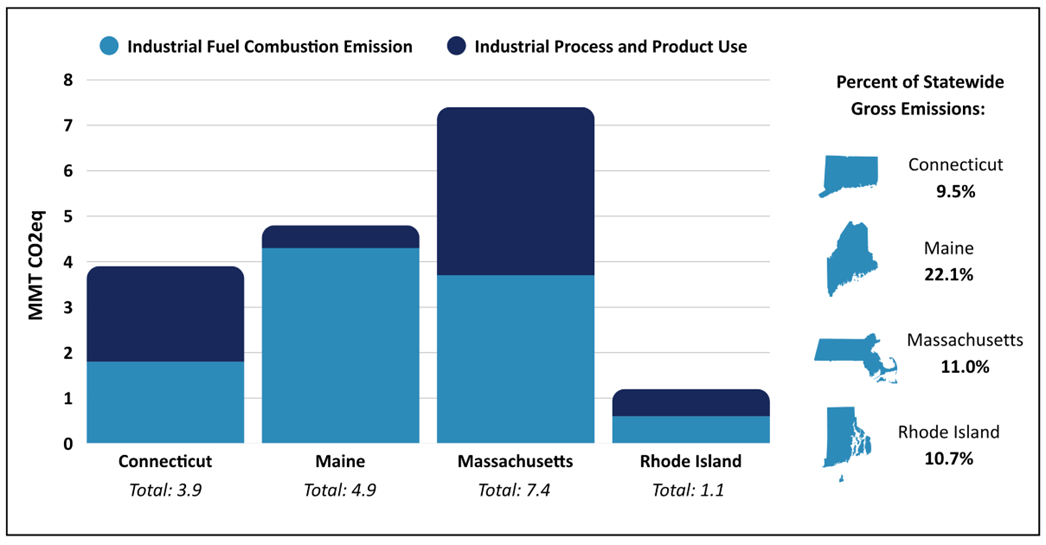
New England’s industrial sector largely consists of facilities that require low- and medium-temperature heating for industrial processes. This heating profile makes them viable candidates for electrification with commercially available technologies, such as industrial heat pumps. The four states covered in this analysis specialize in different industries. Not only that, but they also vary in the total contribution of the industrial sector to state-wide emissions and the share of emissions from fuel combustion versus industrial processes and product use (Figure 1). Electrification can reduce emissions from fuel combustion for heating by using cleaner electricity instead.
Figure 1. Industrial sector direct greenhouse gas emissions in 2021 in four New England states
Sources: Massachusetts Department of Environmental Protection. 2024. Massachusetts Annual Greenhouse Gas Emissions Inventory: 1990-2021.
Connecticut Department of Energy & Environmental Protection. 2024. Connecticut Greenhouse Gas Emissions Inventory: 1990-2021.
Rhode Island Department of Environmental Management. 2024. 2021 Rhode Island Greenhouse Gas Inventory. Available at: https://dem.ri.gov/sites/g/files/xkgbur861/files/2024-06/RIDEM-ghg-inventory-2021_0.pdf.
Maine Department of Environmental Protection. 2024. Tenth Biennial Report on Progress Toward Greenhouse Gas Reduction Goals.
Our report reviews the technical and economic potential for industrial facilities to electrify with industrial heat pumps in these four New England states. Heat pumps are a highly efficient technology that can provide hot water and steam for industrial processes using far less energy than boilers using conventional fuels. We find that electrification would reduce net GHG emissions by nearly 2 million metric tons per year in the studied facilities and states, a 24 percent reduction. For Maine, which has a large and high-emitting pulp and paper industry, these emissions reductions represent 6 percent of statewide emissions, indicating Maine will be challenged to meet its climate law without decarbonizing these facilities.
We also find that just over half of the industrial facilities we studied are located near or within environmental justice (EJ) communities. While individual states’ definitions vary, EJ communities are those with lower income, made up predominantly of people of color, or with a high proportion of people who are not primarily English speakers. These communities face disproportionate public health and environmental harms after decades of unequal treatment. Electrification of these facilities would eliminate onsite heating equipment that burns fossil fuels, alleviating the burden on nearby EJ communities.
Lastly, we find that replacing existing equipment with electric heat pumps instead of like-for-like fossil fuel systems would reduce total costs in over one quarter of the facilities studied. We analyzed the levelized cost of heating (LCOH) at each facility, comparing capital, operating, and energy costs over the lifetime of either conventional fuel-based or electrified heating technologies. When we consider the societal benefits of reducing GHG emissions, nearly three quarters of facilities we analyzed would reduce total costs if they electrified. Other Synapse reports analyzing facilities in Colorado, Illinois, and California have shown how an additional mechanism, reforming electricity rates for industrial customers, could lower electricity bills for industrial facilities that electrify. This approach could also improve the economic case for industrial electrification in New England.
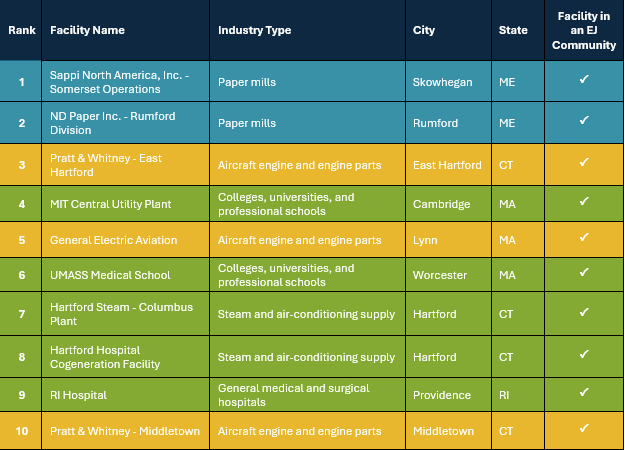
Based on these results, we prepared a prioritization scheme for identifying and highlighting the most important facilities for near-term electrification efforts. The prioritization metrics include electrification cost-effectiveness (40 percent of final score), GHG emissions reduction potential (35 percent), and whether a facility is in an EJ community (25 percent). Table 1 shows the top 10 priority facilities, ordered from highest to lowest priority. Notably, the top 10 facilities fall into three industry groups: pulp and paper (in blue), cogeneration plants (in green), and aircraft engines and parts (in yellow).
Table 1. Prioritized facility list for electrification in this study
Our study shows that industrial heat pumps for low- to medium-temperature processes are efficient, cost-effective today, and can quickly cut emissions. Given this context, policymakers should seek to accelerate industrial electrification by offering practical financial support—like rebates, tax credits, or low-interest loans—to make cleaner electric equipment as affordable as conventional systems for plant owners, with a special focus on the highest-impact facilities and sectors. Policymakers should also make sure funding reaches facilities in environmental justice communities so that cleaner air and other health benefits are shared equitably. Other supportive policies can help states leverage industrial electrification to meet climate laws, such as reforming electricity rates for industrial customers and improving data sharing between governments, utilities, and industrial leaders.
Read the summary report for policy makers and the full technical report here. Also, check out Conservation Law Foundation’s accompanying blog post and interactive story map of facilities.