PG&E’s Undergrounding Program Benefits Shareholders More Than It Reduces Wildfire Risk
After PG&E equipment caused devastating wildfires, CEO Patti Poppe announced a “moonshot”: bury 10,000 miles of power lines underground to reduce wildfire risk. Undergrounding up to that point had occurred in the tens or hundreds of miles per year, at most. The California Public Utilities Commission subsequently approved $3.7 billion for 1,230 miles of undergrounding from 2023–2026. Now PG&E is seeking another $1 billion for 2027, with billions more to come when the utility files its Electric Undergrounding Plan later this year.
So, after several years and billions of dollars, it’s worth asking a basic question:
Is PG&E actually undergrounding the power lines that pose the greatest wildfire risk?
As demonstrated in my rate case testimony for The Utility Reform Network (TURN), PG&E’s own data suggest the answer is often ‘no’.
Undergrounding is necessary. But targeting matters.
California faces enormous wildfire risk, and undergrounding absolutely has a role in reducing it. But it is also extremely expensive, time-intensive, and complex. Ratepayers should therefore expect PG&E to concentrate undergrounding on the riskiest infrastructure. PG&E has roughly 25,500 miles of distribution lines in what has been determined are “high” wildfire-risk areas. But PG&E’s own models show that some of these lines pose dramatically more risk than others.
That makes prioritization of the highest-risk infrastructure absolutely critical.
If PG&E cannot effectively target the highest-risk lines, ratepayers are better served by less expensive and faster measures—such as overhead hardening, proper equipment maintenance (which would have prevented the Camp Fire in 2018), and targeted Public Safety Power Shutoffs (PSPS), and more sensitive line settings (EPSS). Indeed, despite all the rate increases and billions of dollars spent on undergrounding, these are the programs that have predominately reduced wildfire risk in PG&E’s service territory over the last 7 years.
PG&E’s own data show the undergrounding program’s targeting of highest-risk infrastructure has been quite poor
Consider projects selected using PG&E’s “WDRMv2” wildfire risk model (the model most used since this undergrounding program began). Of the 584 undergrounding miles completed using that model, PG&E’s data show:
- 64% were in the bottom half of modeled wildfire risk.
- 25% were in the bottom 10% of risk.
- Of the 681 miles contained in the highest 10% of risk, PG&E undergrounded just 75 of these miles.
Put another way, PG&E could have completed all 584 of those undergrounding miles entirely within the highest-risk 10% of its system. Instead, most were deployed elsewhere.
WDRMv2 UG Miles Completed from Highest to Lowest Risk
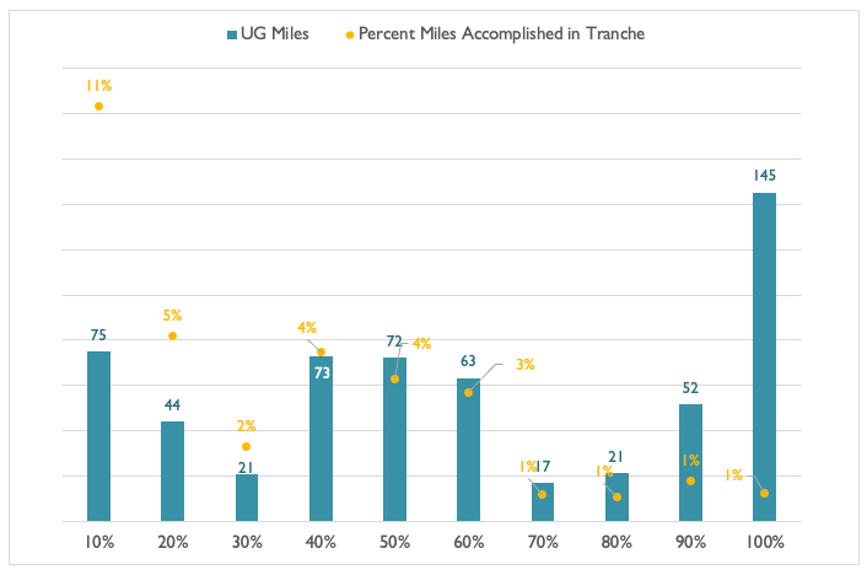
Note: "Percent of miles in tranche" means the number of miles in each 10 percent risk tranche. For example, PG&E completed 75 miles of undergrounding in the top 10 percent of risk, despite their being 681 miles that could have been undergrounded.
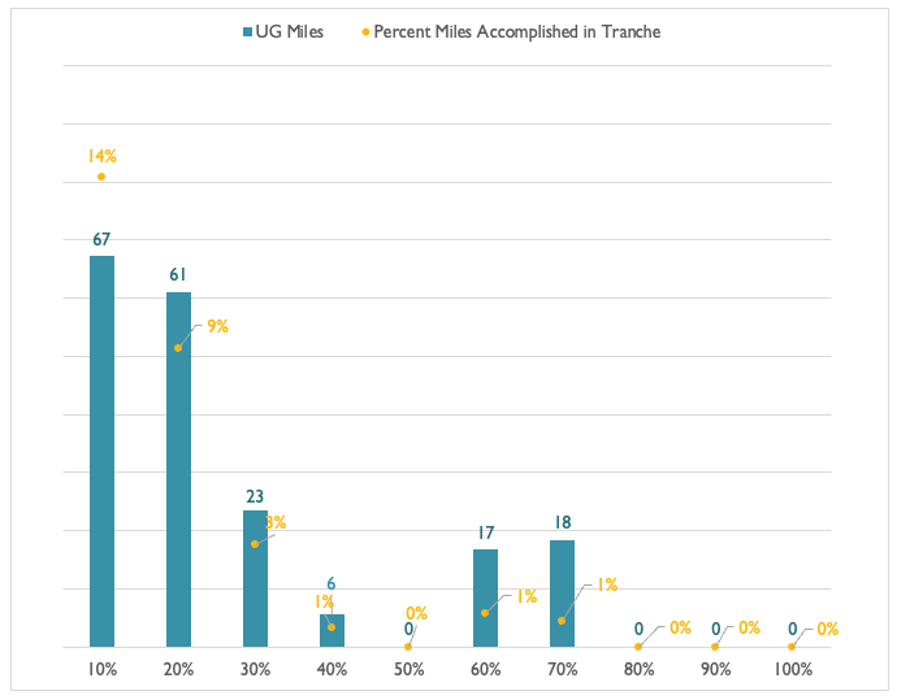
Results improved somewhat under PG&E’s newer WDRMv3 model, but the basic problem remains. Of 192 undergrounding miles using WDRMv3, only 35% were deployed in the highest 10% of risk. Again, PG&E could have underground all 192 miles within that highest-risk category.
WDRMv3 UG Miles Completed from Highest to Lowest Risk
Ratepayers should expect better.
PG&E has reduced wildfire risk through a combination of undergrounding, equipment maintenance, overhead hardening, public power shutoffs (PSPS), line settings, and other programs. Undergrounding should remain part of that strategy. But it should be reserved and targeted to the infrastructure where the enormous cost per mile is justified. This can shrink the absolute size of the program but reduce more risk, if implemented well.
It is an understatement to say that California ratepayers already face significant affordability pressures. Spending billions to underground relatively lower-risk lines while higher-risk infrastructure remains overhead is unacceptable.
The CPUC and Legislature should therefore impose tighter controls on undergrounding expenditures and require PG&E to demonstrate that projects are actually concentrated on its highest-risk infrastructure. Spending can be reduced and put into more promising programs or back in ratepayer pockets. The current paradigm of “spend now, ask questions later” must be reigned in in favor of strict spending caps and accountability measures to target the highest risk infrastructure for undergrounding.
The issue is not whether California should underground power lines; undergrounding clearly has a role in this state to reduce wildfire risk. The issue is whether utilities maximize wildfire-risk reduction for each ratepayer dollar to keep rates affordable and significantly reduce risk of catastrophic wildfires sparked by utility power lines.
So far, PG&E’s data show that customer affordability and maximizing risk reduction are secondary concerns to ever-increasing capital expenditures and accompanying shareholder profits.