Regulatory Loopholes Leading to Unchecked Transmission Costs (and Higher Electric Bills
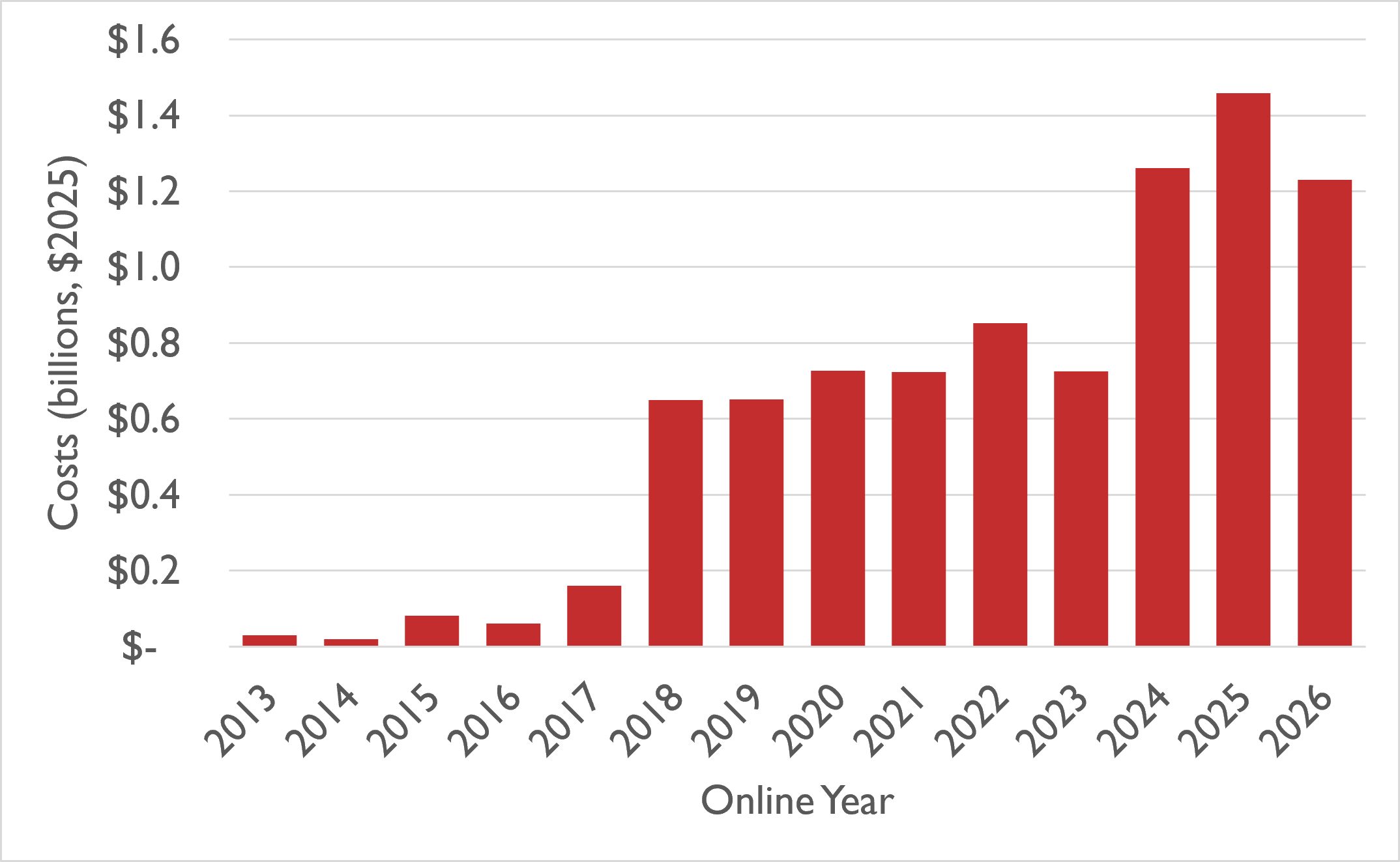
In a time when energy affordability is top of mind nationwide, there’s an alarming lack of scrutiny of spending on certain types of electricity transmission projects. Transmission spending is rising in both ISO New England and PJM, with a growing share of costs driven by local transmission projects. Local transmission projects are infrastructure upgrades, refurbishments, or expansions planned by individual utilities; they are not needed for regional reliability and often lack meaningful regulatory oversight. In New England and PJM regions, local transmission projects now make up a substantial portion of total transmission investments and are growing at a faster rate than regionally planned projects. For example, in New England these project costs have risen from minimal investment of roughly $21 million in 2013 to $1.2 billion in spending in 2026.
This gap in oversight is particularly concerning because transmission owners have a capital bias due to the higher profit they receive when they invest in large capital projects. Without regulatory oversight, costs can rise substantially, driving up costs for all ratepayers. Given the current affordability crisis and the rising energy burden facing many customers, it is important to close existing regulatory gaps and reduce rising costs for customers.
Regional Planning vs. Local Transmission Projects
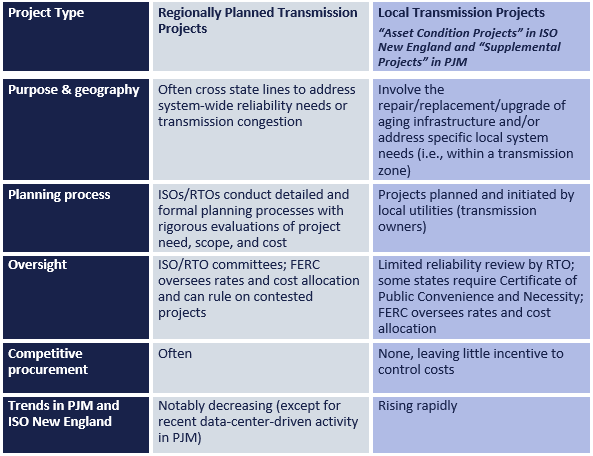
Transmission investments made outside of interconnection-related upgrades generally fall into two types: regionally planned or local transmission projects.
Regionally Planned Transmission Projects
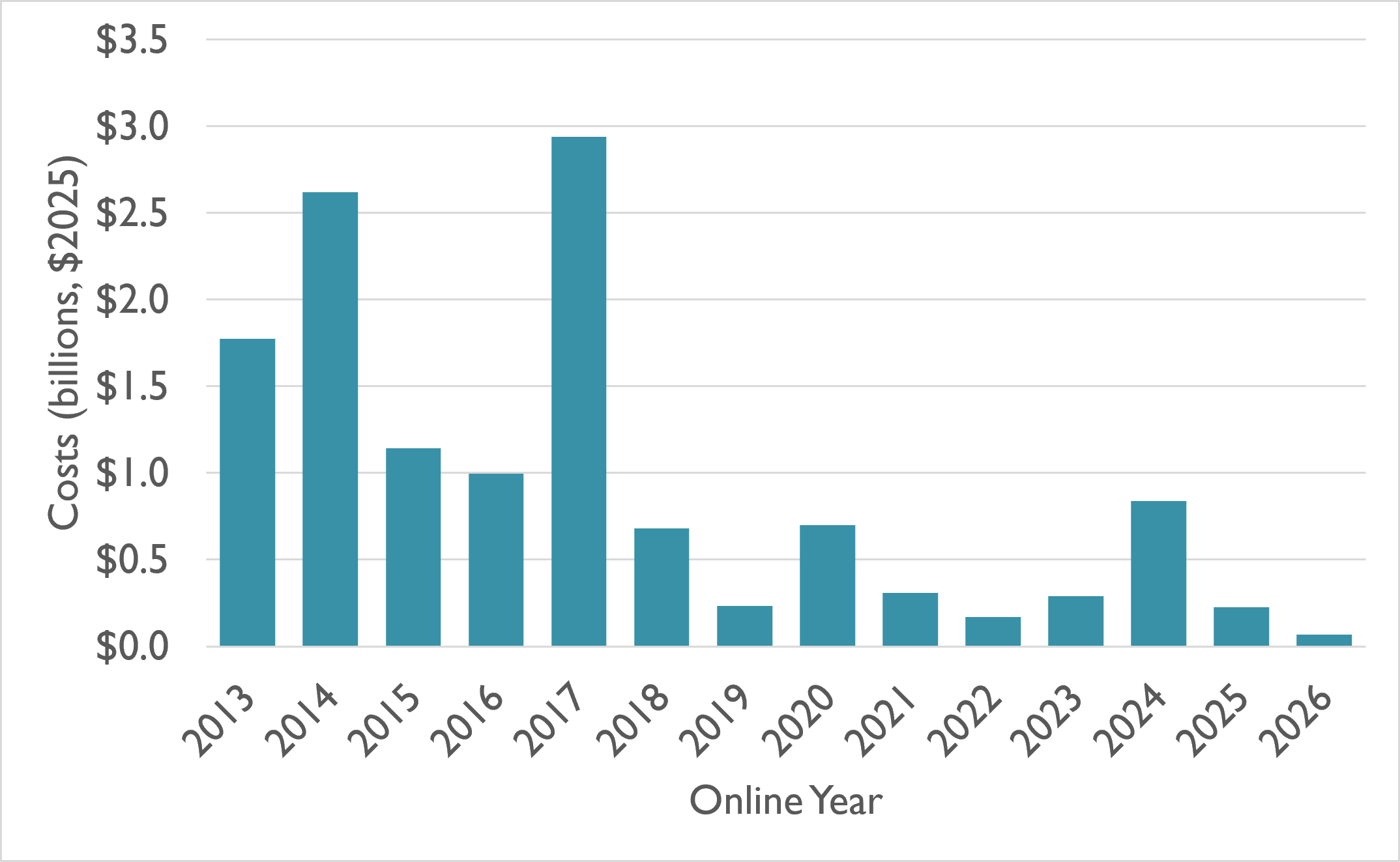
ISO New England’s regional transmission planning happens once every three years, with system needs planned over a 10-year horizon. Figure 1 shows the costs for regional projects in ISO New England, where expenditures have decreased over the last 10 years.
Figure 1. Annual revenue requirements for ISO New England regional transmission projects, by online year
Source: Synapse analysis of data from ISO-NE, Final RPS Project List- October 2025. Available at: https://www.iso-ne.com/system-planning/system-plans-studies/rsp/rsp-project-list-and-the-asset-condition-list.
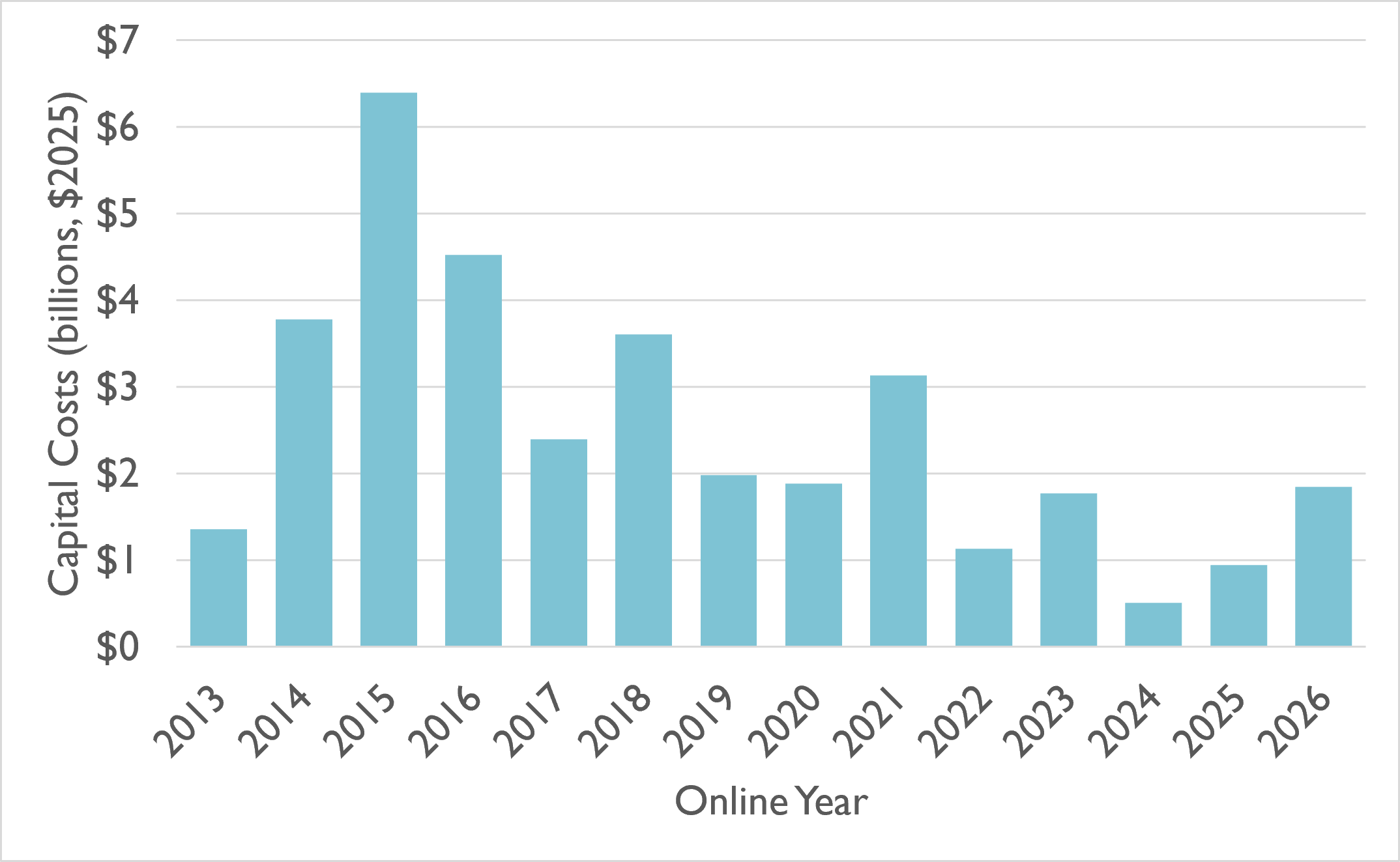
Similarly, in PJM, the RTO annually identifies transmission needs over a 15-year planning horizon and often solicits projects through a competitive process. Figure 2 shows the costs of regional transmission projects in PJM from 2010-2026. Regionally planned transmission projects had been declining, until a recent increase in 2025 due to new data center load in PJM.
Figure 2. Capital costs for PJM regional transmission projects, by online year
Source: Synapse analysis of PJM Project Status & Cost Allocation, data as of February 2026. Available at: https://www.pjm.com/planning/m/project-construction.
Regional transmission project costs are allocated to multiple zones based how benefits flow to each zone, according to established cost allocation methodologies.
Local Transmission Projects
Local transmission projects are driven solely by local utilities (transmission owners) to address specific local system needs (i.e., within a transmission zone), rather than following regional planning frameworks. In ISO New England they are known as “Asset Condition Projects” while in PJM these projects are referred to as “Supplemental Projects.” These projects represent a significant and growing share of total transmission investment. Since they lack the same level of review or oversight as regional transmission projects, there is growing and widespread concern about local transmission project cost escalation and risk of overinvestment, which would impact ratepayers for decades to come.
Asset Condition Projects in ISO New England
In ISO New England, data from the Asset Condition List shows that the number and cost of these projects have grown steadily over time, making up a large share of total transmission spending (Figure 3). Asset condition projects are typically the responsibility of the transmission owner, with costs allocated locally. These investments now amount to $1 billion to $1.5 billion annually. A rough Synapse analysis suggests that even $1 billion per year over just three years would impose a cost burden of around $30 dollars per customer in New England annually. In June 2026, transmission owners in ISO New England added $303 million worth of projects to the Asset Condition List.1,2
Figure 3. Annual revenue requirements for ISO New England Asset Condition Projects, by online year
Source: Synapse analysis of data from ISO-NE, Final Asset Condition List- March 2026. Available at: https://www.iso-ne.com/system-planning/system-plans-studies/rsp/rsp-project-list-and-the-asset-condition-list.
Supplemental Projects in PJM
In PJM, over the last 10 years, Supplemental Project costs have more than doubled (see Figure 4). In PJM, costs are typically allocated to the transmission zone in which the project is located, concentrating impacts on local ratepayers.
Figure 4.
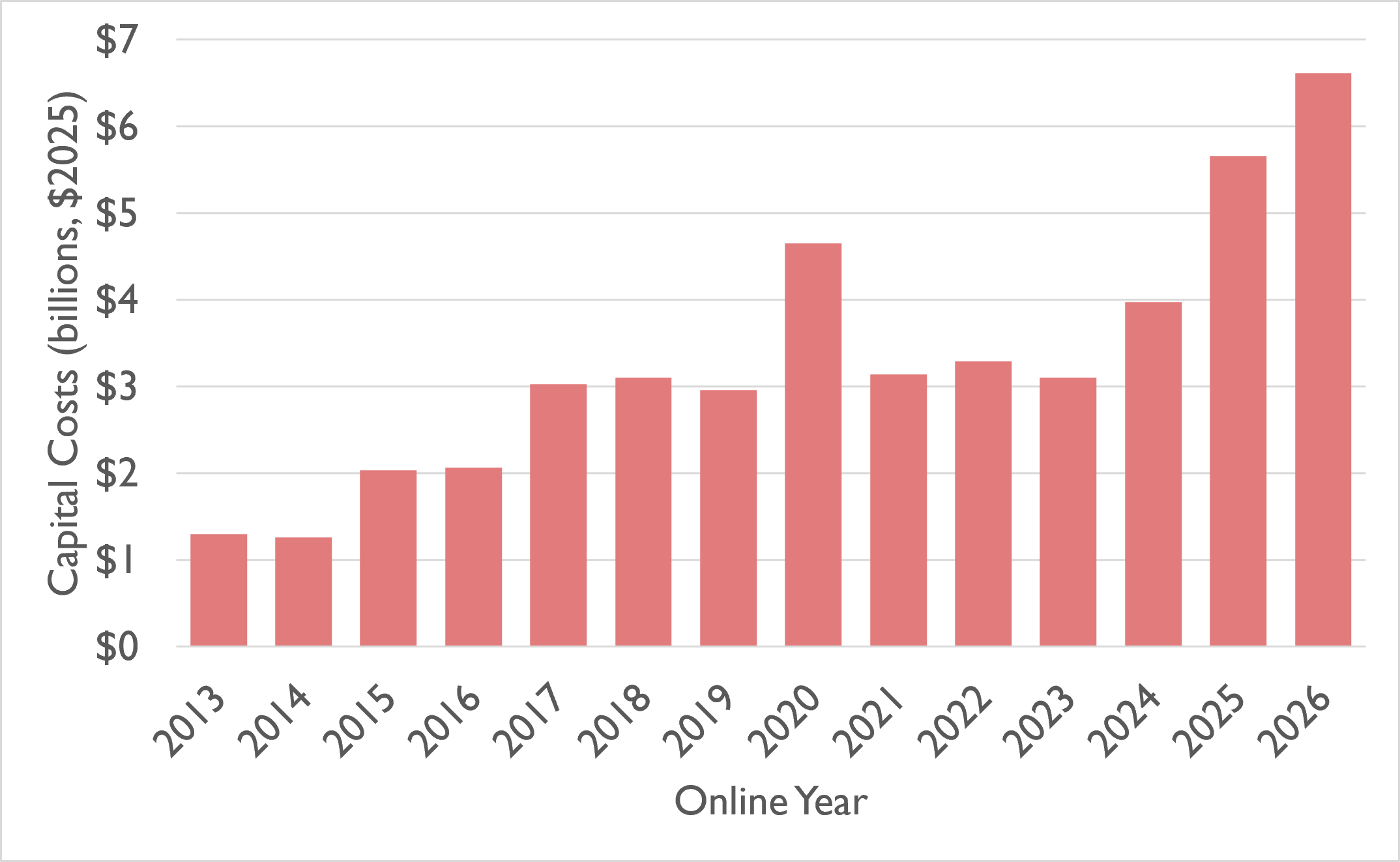
Source: Synapse analysis of PJM Project Status & Cost Allocation, data as of February 2026. Available at: https://www.pjm.com/planning/m/project-construction.
Regulatory Blind Spots
Although local transmission projects are an important part in the transmission system, their transmission owners often exploit gaps in the regulatory system. These gaps allow large infrastructure investments to move forward with limited transparency and accountability.
ISO/RTO planning processes primarily focus on regional needs and have limited authority to oversee local projects, leaving significant discretion to utilities for local transmission projects. At the state level, state commissions require some transmission projects to obtain approval through Certificate of Public Convenience and Necessity (CPCN) processes, however, this process often lacks a detailed review of cost-effective alternatives, and there is often information asymmetry between the transmission owners and states and other participating stakeholders.
The Federal Energy Regulatory Commission (FERC) oversees transmission rates and cost allocation, including for local transmission projects. FERC also retains the authority to approve and reject certain transmission projects, in Section 206 proceedings, but the burden of proof lies with the complainant (such as consumer advocates). Because of the information asymmetry, it can be difficult for challengers to provide the evidence needed to prove that a project is unjust or unreasonable. For example, FERC dismissed a complaint from New Hampshire residents and advocates who challenged Eversource’s proposed $385 million asset condition project on the X-178 transmission line, finding the complaint failed to meet their burden of proof and did not sufficiently show a violation of law or regulation. The project itself would rebuild a 49-mile, 115-kV transmission line that Eversource stated is badly deteriorated and needs major upgrades to improve reliability and resilience. New Hampshire residents and consumer advocates argued the company was pursuing an unnecessarily expensive full rebuild rather than more limited replacements. The complainants also raised broader concerns about weak regulatory scrutiny, limited transparency, and the risk of higher costs for ratepayers. FERC ultimately decided the case was premature since Eversource had not yet sought for cost recovery in rates, but it left the door open for future challenges once the company seeks cost recovery.
Recommendations
Restoring Accountability and Cost Control
Several policy reforms could improve oversight, transparency, and cost control for local transmission projects. Enhancing oversight is critical to ensuring projects are justified and that more cost-effective alternatives receive full consideration.
- Create an Independent Transmission Project Reviewer: Establish an independent asset condition reviewer to evaluate the necessity of proposed local transmission projects, assess lower-cost alternatives such as non-wires solutions, and review cost estimates for accuracy and competitiveness. ISO New England is advancing a proposal to create an independent reviewer to scrutinize asset condition transmission projects. The asset condition reviewer—intended to be strictly advisory—was initially proposed in 2025 with the goal of becoming permanent in 2027. The aim is to improve transparency, consistency, and cost control by providing advisory oversight into project necessity, cost effectiveness, and asset management practices. Although the reviewer will not have authority to approve or reject projects, its findings could support states and consumer advocates in challenging project costs through FERC formula rate proceedings. While many consumer advocates support the scope of work, concerns still remain about potential manipulation to avoid scrutiny, as well as the burden on the RTO to effectively review every project detail. Nevertheless, the reform provides opportunity to increase oversight in New England. The PJM region could implement a similar entity to manage the growing costs of Supplemental Projects there.
- Increase CPCN Oversight: For local transmission projects, state commissions could require an additional layer of oversight to strengthen regulatory review before costs are incurred and passed on to ratepayers, such as through CPCN processes. Enhanced oversight could include better evaluation of project scope and costs, requirement of cost and benefit analyses, and thorough assessments of alternatives. State regulators could also require standard reporting and clear documentation of projects to track cost overruns due to inflation or construction delays.
- Expand Competitive Procurement: States and RTOs could require competitive procurement for Asset Condition and Supplemental Projects, similar to the procurement of regional projects. This could also help reduce costs, encourage innovation in project design, and provide greater transparency by benchmarking utility cost estimates.
Reforming Return on Equity and Capital-Investment Bias
Utilities earn a regulator-approved rate of return on equity (ROE) on their capital investments. Reducing the ROE for local transmission projects (which are relatively low-risk investments and hence don’t require high returns) could better align returns with actual project risk. Such a move would also protect customers by reducing incentives to overinvest in capital-intensive solutions and encouraging more cost-conscious decision-making.
FERC recently decided to reduce established ROE for transmission owners in New England by 100 basis points from 10.57 to 9.57 percent, following a long-running series of legal challenges dating back to 2011. The decision stems from disputes over whether previous ROE levels were just and reasonable, with consumer advocates arguing they were too high. FERC ultimately refined its ROE methodology, adding an additional risk premium model and setting a new rate for transmission owners.
Similar battles are happening outside New England. American Municipal Power (AMP) and consumer advocates in Ohio and Maryland are challenging a proposed return on equity (ROE) of 10.66 percent and the cost allocation for a roughly $1.1 billion transmission project under development by AEP and FirstEnergy to support data center growth. The consumer advocates argue the ROE would unfairly shift costs and risks onto ratepayers. The case, now before FERC, also highlights broader concerns about how to equitably allocate the costs of rapid load growth and large transmission investments without overburdening ratepayers.
In addition, FERC provides an incentive in the form of higher ROE to electric companies that participate as a member in an RTO, known as the “RTO Adder.” Therefore, states could pass state legislation requiring electric companies that own or operate a transmission line within the state to participate as a member in an RTO or ISO. Under FERC precedent, companies with legally required membership in the RTO are not voluntary and thus are ineligible for the RTO Adder incentive. Removing eligibility for the RTO adder in this way could potentially lower costs for ratepayers.
While local transmission projects are an important part of the interconnected and regional transmission system, they currently lack the robust oversight that regional projects undergo. This issue is pervasive in both ISO New England and PJM. By adopting stronger regulatory measures, regions can better balance cost control, transparency, and effective transmission development. Closing regulatory gaps will help protect ratepayers and ensure all transmission investments serve the public interest.
1 Not shown in Figure 3.
2 Lamson, Jon. June 23, 2026. “ISO-NE Transmission Owners Add $303M to Asset Condition List.” RTO Insider. Available at: https://www.rtoinsider.com/135076-iso-ne-transmission-owners-add-303m-a…